Series № 9 of 9 Acreage Kitchens
Bleach, Vinegar or a Tablet: Cleaning a Viking Dishwasher Safely
Bleach is the wrong tool for a stainless dishwasher tub. Here is the routine that works in a Woodinville kitchen, plus the signs that mean a repair rather than a dirty machine.
Written by
Sofia Alarcon
- Role
- Service technician — refrigeration and defrost
- In the trade
- 15 years in the trade
Why bleach and a stainless tub do not mix
The plain answer is no, at least not as a routine cleaner. Viking dishwashers, like most premium machines, are built around a stainless steel tub, and chlorine bleach is one of the few household chemicals stainless tolerates poorly. Chlorine eats into the thin invisible layer that keeps the steel from rusting, and the damage shows up as dull patches, pinhead pits or orange freckles along the tub floor.
Rubber suffers too: the door gasket and pump seals stiffen with repeated bleach exposure, and a hardened door seal is how a spotless machine begins dripping onto a hardwood floor.
Worse, bleach meeting vinegar, an acidic cleaner or ammonia releases a toxic gas, and a dishwasher fresh from a vinegar run still holds a little acid in its sump.
Card 1 of 9 · (425) 321-3414
What is really behind the smell and the film
Most people reach for bleach because of an odor or a cloudy coating on the glassware. Those nearly always trace back to food packed into the filters, water that never fully pumps out, or leftover detergent and minerals. Bleach cures none of that; it only hides the smell for a few days.
Western Washington’s damp months make it worse, because a closed dishwasher stays humid between loads. Once the evening load is done, prop the door slightly ajar overnight so the moisture has somewhere to go.
Card 2 of 9 · (425) 321-3414
Brush the filters every week
Viking’s use-and-care instructions for its current built-in VDWU and FDWU dishwashers call for a filter clean at least once a week:
- Pull the bottom basket all the way forward.
- Twist the combined micro and coarse filter assembly counterclockwise and lift it out.
- Take out the flat filter too, so you have three pieces in hand.
- Scrub all three under running water with a soft brush; a retired toothbrush gets into the mesh nicely.
- Refit the flat filter, drop the assembly into place and turn it until it clicks.
No click means the assembly is not locked, and a loose filter lets seeds and glass chips travel on toward the pump.
Card 3 of 9 · (425) 321-3414
A monthly deep clean: tablet or vinegar
With a cleaning tablet
- Empty the racks and brush the filters first.
- Follow the packet on placement; most tablets sit in the detergent cup, a few go loose on the tub floor.
- Pick the hottest, longest program and leave the detergent out.
- Afterwards, wipe the door edge and the gasket with a damp cloth.
With white vinegar
Set one cup of plain white vinegar upright in a dishwasher-safe bowl on the top rack and run a hot program with the machine otherwise empty. It loosens mineral scale and soap film well, but as an acid it belongs in the occasional column, since frequent acid washes are hard on rubber. Leave at least a full day between vinegar and any bleach-based product.
Card 4 of 9 · (425) 321-3414
Set the rinse aid to match your glasses
Spots and haze often point to the rinse aid rather than a dirty tub. The VDWU and FDWU dishwashers offer settings from P:0 to P:4, releasing anywhere from zero to four doses per cycle, and they arrive set at 3. Stained or spotted glasses call for a higher number. If a bluish streak rubs off a glass under your fingertip, the dose is too heavy and should come down a step.
Card 5 of 9 · (425) 321-3414
Septic tanks and bleach in Cottage Lake and Hollywood Hill
Plenty of larger-lot homes around Cottage Lake and Hollywood Hill send their wastewater to a private septic tank rather than a sewer main. The tank relies on bacteria to break waste down, and chlorine bleach kills bacteria without discrimination. One cup will not ruin a healthy tank, but regular bleach cycles stacked on top of laundry bleach and bathroom sprays add up. Our piece on what private wells and septic systems do to a Viking dishwasher covers the rest of that picture.
Card 6 of 9 · (425) 321-3414
A simple maintenance calendar
| Task | How often | Who does it |
|---|---|---|
| Brush the three filters | Weekly | You |
| Wipe the door gasket and tub edges | Monthly | You |
| Tablet or vinegar cycle, empty tub | Monthly | You |
| Check rinse-aid level and setting | Whenever you refill it | You |
| Pump, spray arms, hoses, drain loop, door seals | When symptoms appear | Technician |
Card 7 of 9 · (425) 321-3414
Codes that point past a dirty tub
Some symptoms have nothing to do with dirt. When a VDWU or FDWU flashes E:01, its sensors have picked up too much water or a leak and the drain pump runs to empty the tub; a code that keeps coming back is a job for a technician. E:02 says no water is reaching the machine, so first make sure the supply valve under the sink is fully open. The VDWU724 and FDWU724 simply pause on E:02 and resume once water flows.
Older Viking units made before May 26, 2010 report a Drain Timeout by flashing their cycle buttons. Check the sink drain, a newly fitted disposal whose knockout plug was never removed, the drain hose for clogs, kinks or a sagging high loop, then the leveling and the filters.
Card 8 of 9 · (425) 321-3414
When to stop and book a technician
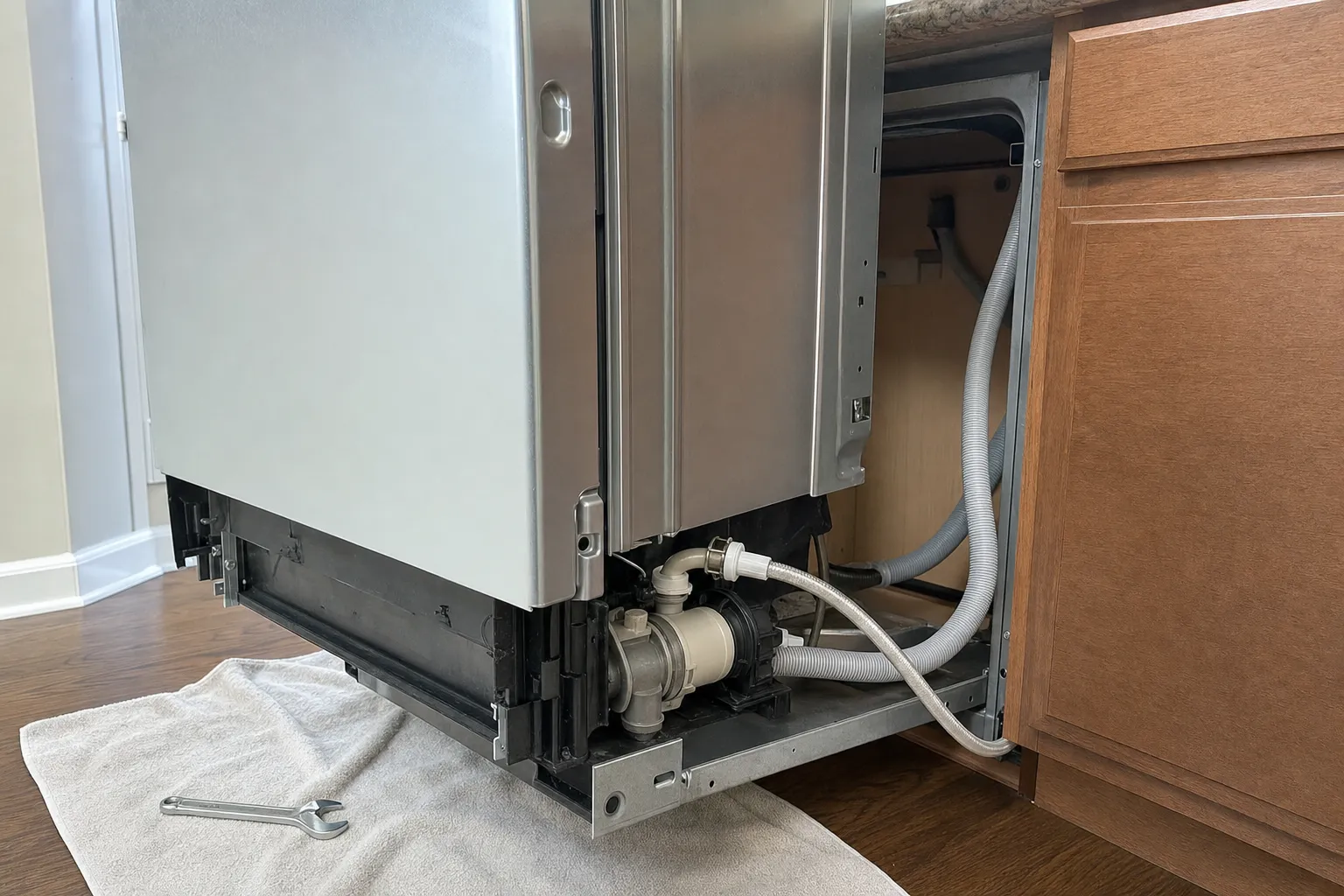
Standing water, a hot electrical smell or a wet floor all mean stop running cycles. A visit covers what is hard to do at the counter: sliding the unit out (panel-ready models sit inside cabinetry), testing the pump and its seals and clearing the drain path. Replacing a pump or a control costs well beyond a season of cleaning tablets, and the firm price comes only after diagnosis. Our visit is a flat $89 that pays for the drive out and the diagnosis, and we take it off the bill if you approve the repair.
In years three through five of ownership, Viking still furnishes certain named dishwasher parts, but the technician’s time and the freight are yours to pay. More on our Viking dishwasher repair work, or phone (425) 321-3414.
Card 9 of 9 · (425) 321-3414
Follow-ups
Can I use vinegar to clean my dishwasher?
Yes, now and then. Stand one cup of plain white vinegar in a dishwasher-safe bowl on the top rack and run a hot, empty cycle. Because it is acidic, keep it occasional and never use it on the same day as bleach. If white film returns within a week, Woodinville Viking Repair can find out why.
How do I use a dishwasher cleaning tablet?
Put the tablet where its packet says, usually the detergent cup, and run the hottest program with the tub empty and no detergent. Brush the filters beforehand and wipe the gasket afterwards. Monthly suits most kitchens; if a tablet leaves the odor behind, ring (425) 321-3414.
Why does my dishwasher still smell after a cleaning cycle?
Usually the filter or the sump is still holding scraps or stale water. Brush the filters and watch whether the tub drains dry. Water left sitting in the bottom points to the drain hose, the high loop or the pump, which Woodinville Viking Repair can trace on a visit.
Is a high loop or an air gap better for a dishwasher drain?
Neither is better in general; each one prevents used sink water from flowing backwards into the wash tub. A high loop lifts the drain hose up under the countertop, while an air gap is a small fitting on the sink deck. Local plumbing code decides which your kitchen needs, so ask Woodinville Viking Repair before rerouting anything.